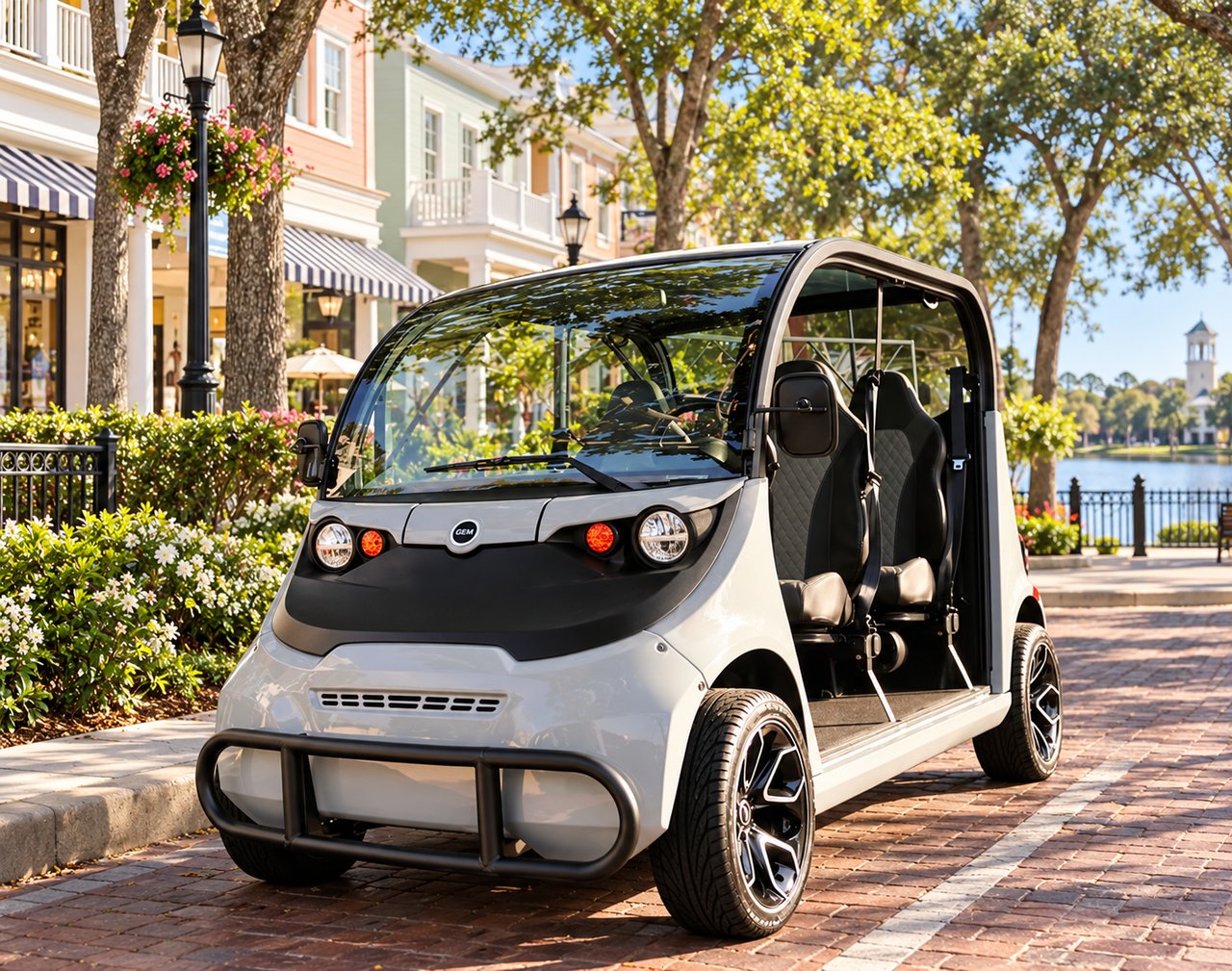
Drive through downtown Celebration on any weekday afternoon and you'll pass a dozen small electric cars gliding along at a speed that feels almost deliberate. Kids ride in the back seat on the way home from practice. A driver waves at a neighbor from the open side. Somebody's dog has its head out the window. Everybody in town calls them golf carts, and almost nobody who owns one is actually driving a golf cart under Florida law.
They're low-speed vehicles, a distinct legal category the state defines with more precision than most residents realize, and the fine print under that category shifted in ways that haven't fully caught up with what people repeat to each other at the mailbox.
What the State Actually Calls These Things
Florida law splits small electric vehicles into two separate boxes, and the difference isn't cosmetic. A golf cart, under Florida Statutes, tops out under 20 miles per hour and was built for a golf course, not a subdivision. A low-speed vehicle, or LSV, which is the category that covers what Celebration calls a Neighborhood Electric Vehicle, is a completely different animal on paper even when it looks nearly identical on the road. Florida's own statute defines it this way:
"Low-speed vehicle" means any four-wheeled electric vehicle whose top speed is greater than 20 miles per hour but not greater than 25 miles per hour, including neighborhood electric vehicles.
That's a narrow band, 20 to 25 miles per hour, and it comes with obligations a golf cart never had. An LSV has to be registered with the state, titled, and insured, and the person behind the wheel needs a valid driver's license. It also has to carry equipment a golf cart doesn't: headlights, brake lights, turn signals, a windshield, seat belts, a parking brake, and a vehicle identification number. A golf cart, by contrast, has historically skipped registration and insurance altogether, governed instead by a lighter set of road-use rules.
The vehicles Celebration built its identity around were never the loose category. They were always the stricter one.
The Number That Gets Misremembered
Ask around town how fast one of these things actually goes and you'll sometimes hear a figure closer to 35 miles per hour than 25. That number isn't wrong, exactly. It's just describing the wrong thing.
Florida law caps low-speed vehicles at 25 miles per hour, full stop, as a matter of federal and state vehicle classification. What tops out at 35 is the road, not the car. State law only allows LSVs onto public streets where the posted limit is 35 miles per hour or lower. That 35 is a ceiling on where the vehicle is permitted to drive, and it's easy to see how the two numbers get swapped in casual conversation until the vehicle's actual top speed and the road's speed limit blur into one figure.
Inside Celebration, that distinction plays out on real streets. Most of the town sits at a 25 mile-per-hour limit, which matches the LSV's own cap closely enough that the cars fit the roads without much friction. Water Tower Place is the exception locals mention: the posted limit there climbs to 35, which is still technically legal for an LSV to use, but it's also the stretch where a vehicle that weighs around 1,200 pounds, with no fixed doors and no crash structure to speak of, is sharing a lane with regular traffic moving at the outer edge of what the law allows it to encounter at all.
The hard stop is State Road 192, where the limit runs 45 miles per hour. That's above the legal ceiling for any LSV, which means the vehicle that gets a family across town in minutes can't legally make the short hop across 192 to reach a Publix or a shopping plaza just past the town line. It's not a matter of caution. It's the point where the vehicle's permitted world ends.
The Rule That Changed, and the One That Didn't
Florida tightened its golf cart statute in 2023, and the change was aimed squarely at the looser category, not the one Celebration's vehicles fall under. Before that update, a 14-year-old could legally drive a golf cart on designated public roads without a license or any formal training. Lawmakers revisited that after crash data showed how much of the actual risk was happening away from golf courses entirely, out on ordinary residential streets where carts had become everyday transportation rather than course equipment. Statewide figures cited earlier this year put golf cart crashes at an estimated 15,604 emergency room visits in a typical year, with about seven in ten of those happening off the course, on public streets and private property.
That 2023 change targeted golf carts specifically. It didn't loosen or tighten anything for low-speed vehicles, because LSVs were already operating under the stricter framework: registration, insurance, and a licensed driver were never optional for them the way they were for a golf cart before the law caught up. Which means the actual risk for someone in Celebration isn't confusing an NEV with a golf cart and assuming the 2023 changes don't apply. It's assuming the opposite, that because the vehicle looks like a golf cart and has always been treated like a casual, low-stakes purchase around town, the paperwork that legally attaches to it, particularly on a secondhand buy from a neighbor, is optional too. A legal summary published by BDI School puts it plainly: "Community habits don't override state definitions or local ordinances."
A Town Built Around a Category Before the Category Was Common
Celebration adopted these vehicles early, well before most planned communities in Florida had any meaningful population of them, and for years the culture around buying one ran almost entirely on word of mouth. A downtown dealership once called NEVrland handled new sales, and secondhand vehicles tended to change hands through the town's own resident network rather than a dealer lot. That informal path is part of why the folklore around top speeds and road rules has had so much room to drift over two decades. There was no single point of sale correcting the record every time a used four-seater passed from one driveway to the next.
The mix-up isn't only internal. Ask a visitor waiting outside one of Celebration's coffee spots what the small car idling at the curb is, and the answer that comes back is almost always "a golf cart, you can rent one to drive around here." It's an understandable guess. It's also exactly backward. The vehicle sitting there is registered, insured, and driven by someone with a license, doing something a golf cart legally isn't built to do on that same street.
What This Actually Means for Anyone Weighing One
None of this makes an NEV a bad fit for life in Celebration. If anything, the town's layout, its 25 mile-per-hour interior streets, its walkable core, its short trips to the farmers market or a neighbor's driveway, is close to the ideal use case the low-speed vehicle category was written for. The point isn't that the vehicles are wrong for the town. It's that the legal category they fall into asks more of an owner than the "it's basically a golf cart" version of the story suggests.
That matters most at two moments: when a vehicle changes hands and when a household adds a new driver. Buying a used NEV through a neighbor or a community listing means confirming the registration and title actually transferred, not just the keys. Handing the wheel to a teenager means confirming they hold a valid license, because the LSV requirement never had the golf cart's looser age allowance to begin with, before or after 2023.
The vehicles gliding through Celebration at 25 miles an hour are one of the clearest physical expressions of how the town was designed to be used. Getting the legal category right doesn't change how it feels to drive one down Front Street on a Sunday morning. It just means the paperwork in the glove box matches the vehicle actually parked in the driveway.
Questions about how a specific street, village, or HOA in Celebration treats vehicles like these tend to come up more often than people expect once they're looking closely at a property here. If that's the kind of granular, block-by-block detail you want before making a move in this market, Tiffany Baro has spent two decades tracking exactly this kind of local nuance. Let's Connect.
This article is general information, not legal, tax or financial advice. Consult a qualified professional about your situation.